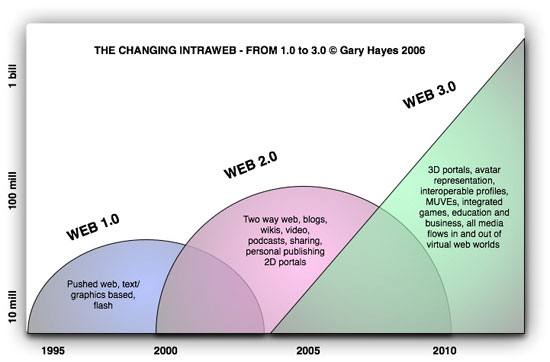
Google CEO Eric Schmidt was recently at the Seoul Digital Forum where he was asked to define Web 3.0 by an audience member.
Showing posts with label Future Internet. Show all posts
Showing posts with label Future Internet. Show all posts
Wednesday, 8 August 2007
Thursday, 2 August 2007
Spies watch rise of virtual terrorists

THE bomb hit the ABC's headquarters, destroying everything except one digital transmission tower. The force of the blast left Aunty's site a cratered mess.
Just weeks before, a group of terrorists flew a helicopter into the Nissan building, creating an inferno that left two dead. Then a group of armed militants forced their way into an American Apparel clothing store and shot several customers before planting a bomb outside a Reebok store.
This terror campaign, which has been waged during the past six months, has left a trail of dead and injured, and caused hundreds of thousands of dollars' damage. The terrorists belong to a militant group bent on overthrowing the government. But they will never be arrested or charged for their crimes because they have committed them away from the reach of the world's law enforcement agencies, in the virtual world known as Second Life.
Read More


Friday, 22 June 2007
U.S. general laments Google Earth capability
 The head of U.S. Air Force intelligence and surveillance on Thursday said data available commercially through online mapping software such as Google Earth posed a danger to security but could not be rolled back.
"To talk about danger is, if I may, really is irrelevant because it's there," said Lt. Gen. David Deptula, deputy chief of staff for intelligence, surveillance and reconnaissance.
Tuesday, 19 June 2007
Turning cars into wireless network nodes
 Taking It to the Streets: UCLA Scientists Seek to Turn Cars Into a Mobile Communications Network
It's no secret Americans love their cars, and modern computer systems have enhanced vehicle performance and safety. For computer science professor Mario Gerla and researcher Giovanni Pau at the UCLA Henry Samueli School of Engineering and Applied Science, the next step is to take that digital processing power and push it outward even further — by using cars as computer nodes in a mobile network on wheels.
Monday, 18 June 2007
Online and offline worlds merge
 Google has launched a tool designed to make it easier for computer users to use online applications offline.
One of the key limitations of web services such as e-mail, word processing and calendars, is that they require a net connection to function.
China To Use Computer Viruses As Cyberwarfare First Strike

The Defense Department reports that the People's Liberation Army is moving beyond traditional battlefields and into cyberspace.
The People's Liberation Army in China is building up its cyberwarfare capabilities, even creating malware that could attack enemy computer systems in first-strike attacks, according to a report from the Department of Defense.
The People's Liberation Army in China is building up its cyberwarfare capabilities, even creating malware that could attack enemy computer systems in first-strike attacks, according to a report from the Department of Defense.
A Smarter Web
 New technologies will make online search more intelligent--and may even lead to a "Web 3.0."
 Last year, Eric Miller, an MIT-affiliated computer scientist, stood on a beach in southern France, watching the sun set, studying a document he'd printed earlier that afternoon. A March rain had begun to fall, and the ink was beginning to smear.
Five years before, he'd agreed to lead a diverse group of researchers working on a project called the Semantic Web, which seeks to give computers the ability--the seeming intelligence--to understand content on the World Wide Web. At the time, he'd made a list of goals, a copy of which he now held in his hand. If he'd achieved those goals, his part of the job was done.
Thursday, 14 June 2007
New tech may boost indoor mobile coverage

A new technology to boost the indoor coverage of mobile-phone networks — and a possible rival to combined fixed-mobile offerings, such as BT's Fusion — is set to hit the mass market in less than a year, a manufacturer said.
Several companies are developing so-called femtocells, small indoor base stations for third-generation mobile-phone networks, allowing operators to improve indoor coverage at a substantially lower cost than the traditional way of adding more cell towers.
NATO says urgent need to tackle cyber attack
 NATO defense ministers agreed on Thursday that fast action was needed to tackle the threat of "cyber attacks" on key Internet sites after Estonia suffered a wave of assaults on its computer networks last month.
"There was sentiment round the table that urgent work is needed to enhance the ability to protect information systems of critical importance," NATO spokesman James Appathurai told a news conference at a two-day meeting in Brussels.
China won't scrap blog registry
 New rules by a Chinese government-backed Internet group maintain strict controls over the country's bloggers, requiring them to register with their real names and identification cards
.
The guidelines from the Internet Society of China (http://www.isc.org.cn), a group made up of China's major Internet companies, contradict state media reports this week claiming that China was considering loosening registration requirements for bloggers to allow anonymous online journaling.
Read More
Aerospace companies target young recruits online
 Justin Wong, an aerospace engineering student from the Massachusetts Institute of Technology, was schmoozing on Facebook.com last fall when he came across a sleek Boeing job ad.
Wong, who had just interned at the aerospace company, saw the banner on the popular social networking site as a "two-way street" — a defence behemoth reaching out to today's youth in their virtual playground.
"My first impression was that Boeing is getting with the times," said the 21-year-old senior, who will work at Boeing's satellite division after graduation. "It shows the company is making an effort to talk to us on our level."
The Reality of Terrorist Cyber War
 Terrorist groups can use the Internet to create a brand image, market themselves, recruit followers, raise capital, identify partners and suppliers, provide training materials, and even manage operations.
Tuesday, 12 June 2007
Wednesday, 6 June 2007
What the attacks on Estonia have taught us about online combat.
In Estonia, you can pay for your parking meter via cell phone, access free Wi-Fi at every gas station, and, as of two months ago, vote in national elections from your PC.
The small, wired country can now add another item to this list of technological achievements: It's the first government to get targeted for large-scale cyberwarfare.
Tuesday, 29 May 2007
Terror And Crime Go Digital
 Emerging digital technologies to move money instantaneously and anonymously open up new possibilities for criminals and terrorists, while regulatory and law-enforcement agencies are limping far behind.
On May 3, at the release of the 2007 Money Laundering Strategy (pdf), the U.S. Treasury spokesperson was pleased to note: "Focusing on well-established money laundering methods and emerging trends identified in the Assessment, we have created a robust strategy for combating money laundering, deterring criminals, and addressing areas vulnerable to exploitation."
Yet the latest digital advances open to criminals and terrorists -- mobile phones or other mobile devices to secretly transfer money globally, or M-payments; gambling; and transfer of virtual money through online role-playing games, or RPGs -- are missing from this long-awaited government strategy.
Read More
Monday, 28 May 2007
Cyber-thieves 'richer than drug dealers'
 A major global malware epidemic is putting greater wealth into the hands of criminals than ever before, according to new research from security software vendor PC Tools.
The company's Malware Research Center has witnessed disturbing trends such as blended attacks, a proliferation of 'toxic' root-kits and a 120 per cent increase in new crime-based threats.
Friday, 25 May 2007
U.S. Navy Puts Rush on Wireless Network to Aid Sea Boarding
 By ZACHARY M. PETERSON
A new wireless technology that bolsters a U.S. Navy boarding team’s ability to conduct interdiction operations at sea is being fast-tracked to the fleet.
The Expanded Maritime Interception Operations wireless system (EMIO) provides a link between Navy ships and boarding teams in maritime interdiction operations. The new system makes data more accessible and in less time. With the new technology, boarding teams can maintain contact with their parent ship during the entire boarding and inspection process.
For the first time, teams will be able to relay biometrics, fingerprints, scanned documents and digital photographs back to their home ships.
Wednesday, 23 May 2007
Cyber terror threat is growing

Terrorists could attempt to cause economic chaos or plane crashes in an electronic attack on the UK's computer networks John Reid, the Home Secretary, said yesterday.
Mr Reid's warning of the "devastating consequences" of cyber terrorism came as he said the reshaping of the Home Office would enable him to "wake up and think about the security of the nation first and foremost every morning".
Tuesday, 22 May 2007
Web 3.0 Gets Under Way
Semantic technology, which helps computers understand data better, is particularly useful when combining large data sets. It's also useful for search applications because semantic technology lets computers infer relationships among data elements that aren't explicitly defined. A keyword search generally returns only documents that contain the queried keyword. A semantic search would return ones related to the specific meaning of the search term (i.e., military tank but not water tank), as well as those related to synonyms (i.e., armored vehicle).
Read More
Read More
Subscribe to:
Posts (Atom)