Now even the last knotty wire that seemed destined to remain — the power cord — could be on its way out.
Showing posts with label Bandwidth. Show all posts
Sunday, 24 June 2007
MIT cuts the cord
Now even the last knotty wire that seemed destined to remain — the power cord — could be on its way out.
Tuesday, 19 June 2007
Turning cars into wireless network nodes
Taking It to the Streets: UCLA Scientists Seek to Turn Cars Into a Mobile Communications NetworkIt's no secret Americans love their cars, and modern computer systems have enhanced vehicle performance and safety. For computer science professor Mario Gerla and researcher Giovanni Pau at the UCLA Henry Samueli School of Engineering and Applied Science, the next step is to take that digital processing power and push it outward even further — by using cars as computer nodes in a mobile network on wheels.
Labels:
Bandwidth,
C4ISR,
Combat Identification,
Computing,
Future,
Future Internet,
General Technology,
GPS,
Industry,
Innovative Trends,
NCW,
RFID
Monday, 18 June 2007
Online and offline worlds merge
Google has launched a tool designed to make it easier for computer users to use online applications offline.One of the key limitations of web services such as e-mail, word processing and calendars, is that they require a net connection to function.
Thursday, 14 June 2007
New tech may boost indoor mobile coverage

A new technology to boost the indoor coverage of mobile-phone networks — and a possible rival to combined fixed-mobile offerings, such as BT's Fusion — is set to hit the mass market in less than a year, a manufacturer said.
Several companies are developing so-called femtocells, small indoor base stations for third-generation mobile-phone networks, allowing operators to improve indoor coverage at a substantially lower cost than the traditional way of adding more cell towers.
Labels:
Bandwidth,
Femtocells,
Future Internet,
General Technology,
Urban Operations,
WiFi
Top 10 Forecasts from Outlook 2007
Each year since 1985, the editors of THE FUTURIST have selected the most thought-provoking ideas and forecasts appearing in the magazine. Over the years, Outlook has spotlighted the emergence of such epochal developments as the Internet, virtual reality, and the end of the Cold War.
Here are the editors' top 10 forecasts from Outlook 2007:
1. Generation Y will migrate heavily overseas.
2. Dwindling supplies of water in China will impact the global economy.
3. Workers will increasingly choose more time over more money.
4. Outlook for Asia: China for the short term, India for the long term.
5. Children's "nature deficit disorder" will grow as a health threat.
6. We’ll incorporate wireless technology into our thought processing by 2030.
7. The robotic workforce will change how bosses value employees.
8. The costs of global-warming-related disasters will reach $150 billion per year.
9. Companies will see the age range of their workers span four generations.
10. A rise of disabled Americans will strain public transportation systems.
Read More
Here are the editors' top 10 forecasts from Outlook 2007:
1. Generation Y will migrate heavily overseas.
2. Dwindling supplies of water in China will impact the global economy.
3. Workers will increasingly choose more time over more money.
4. Outlook for Asia: China for the short term, India for the long term.
5. Children's "nature deficit disorder" will grow as a health threat.
6. We’ll incorporate wireless technology into our thought processing by 2030.
7. The robotic workforce will change how bosses value employees.
8. The costs of global-warming-related disasters will reach $150 billion per year.
9. Companies will see the age range of their workers span four generations.
10. A rise of disabled Americans will strain public transportation systems.
Read More
Labels:
Bandwidth,
Climate Change,
Future,
Medical,
Robotics,
Unmanned Vehicles
The Reality of Terrorist Cyber War
Terrorist groups can use the Internet to create a brand image, market themselves, recruit followers, raise capital, identify partners and suppliers, provide training materials, and even manage operations.Tuesday, 29 May 2007
A Big Ball of Connectivity
No, it's not a giant beach ball. It's an ultralight, ultraportable antenna tucked inside an inflatable shell that can pull down a superfast broadband satellite connection at any location. The GATR-Com is designed for disaster-relief responders, far-flung video producers and front-line troops—anyone whose job (or life) depends on getting digital information—video, Internet, calls—in and out of remote places.
Friday, 25 May 2007
U.S. Navy Puts Rush on Wireless Network to Aid Sea Boarding
A new wireless technology that bolsters a U.S. Navy boarding team’s ability to conduct interdiction operations at sea is being fast-tracked to the fleet.
The Expanded Maritime Interception Operations wireless system (EMIO) provides a link between Navy ships and boarding teams in maritime interdiction operations. The new system makes data more accessible and in less time. With the new technology, boarding teams can maintain contact with their parent ship during the entire boarding and inspection process.
For the first time, teams will be able to relay biometrics, fingerprints, scanned documents and digital photographs back to their home ships.
Tuesday, 24 April 2007
Internet Routing to Branch Into Space
This month, the U.S. military announced a project to test Internet routing on orbiting satellites.
IRIS (for "Internet Routing in Space") will allow different branches of the military, such as the Army, Navy and Air Force, to communicate with each other instantly and spontaneously. It could also spread to the civilian market to give users in remote locations broadband service where no other electronic communication exists.
Friday, 20 April 2007
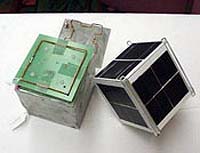
Boeing Pico-Satellite Mission To Advance Miniature Satellite Technology
by Staff WritersSt. Louis MO (SPX) Apr 20, 2007
A pico-satellite developed by Boeing to evaluate miniature spacecraft technologies was successfully launched to orbit on April 17 by an ISC Kosmotras Dnepr rocket from the Baikonur Cosmodrome in Kazakhstan.
Initial system checks indicate that the CubeSat TestBed 1 (CSTB1) spacecraft is operational and ready for a series of on-orbit demonstrations that will help Boeing further develop nano-satellites weighing less than 22 pounds.
Wednesday, 18 April 2007
Reachback: New NATO Approved File Compression Software
NXPowerLite, the file compression software developed by British company Neuxpower Solutions Ltd, has received NATO accreditation after being successfully deployed by Headquarters Allied Rapid Reaction Corps (HQ ARRC) for a demanding military campaign in Afghanistan.
London, United Kingdom (PRWEB) April 18, 2007 -- NXPowerLite, the file compression software developed by British company Neuxpower Solutions Ltd, has received NATO accreditation after being successfully deployed by Headquarters Allied Rapid Reaction Corps (HQ ARRC) for a demanding military campaign in Afghanistan.
NXPowerLite radically reduces the size of Microsoft® Word, Excel® and PowerPoint® files in seconds -- with no discernible loss of quality -- making them easier to use, store and share. It achieves this by intelligently compressing the graphics and embedded documents contained within them. Files retain their original format and remain fully editable, so they can be opened and edited by anybody with a copy of Microsoft® Office. The recipient requires no special viewers or plug-ins and the files do not need to be decompressed before opening.
Typically, reports and briefings used in modern digital military HQs include many pictures, maps and graphics that result in file sizes easily exceeding several megabytes. Large files such as these would be difficult or impossible to email or share across the military networks available in Afghanistan, where network and communication capabilities are not to the same high standards enjoyed in Europe and elsewhere in the developed world. HQ ARRC therefore deployed NXPowerLite to help reduce the size of these files.
The usage of NXPowerLite during the nine month campaign was a huge success, to the extent that all staff now routinely optimize their files using NXPowerLite before delivery. Due to the success of NXPowerLite in Afghanistan, NATO accreditation for the usage of the software on all NATO systems has been gained -- thus ensuring its continued use once the ARRC returned to its peacetime location.
"NXPowerLite has proven itself to be a very effective and simple to use tool," commented Paul Jochimsen, Wing Commander RAF, SO1 Information Knowledge Management. "It has contributed to the minimizing of pressure on network overheads; ensuring optimal and rapid passage of information; reducing data backup overheads and as a result, provided a major contribution to increased staff tempo during a very demanding military campaign."
"Our staffs want to produce materials to the highest standard and do not wish to compromise on the quality of work produced. NXPowerLite has provided for us the bridge between the art of the possible and the ultimate user requirement. The software has been thoroughly tested under the most rigorous of operational circumstances and was never once found wanting."
NXPowerLiteTM costs just $45 per user, with discounts available for bulk licensing. It is available to purchase from http://us.rd.yahoo.com/dailynews/prweb/bs_prweb/storytext/prweb519283/22683197/SIG=10s7faij5/*http://www.nxpowerlite.com and all good software resellers. A fully functional trial version can be downloaded from the website.
Monday, 16 April 2007
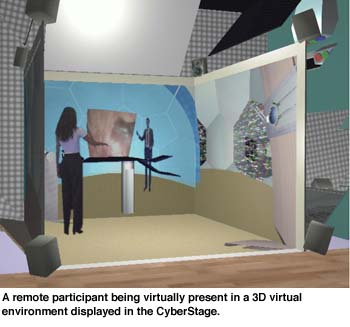
The Telepresence Promise
What's wrong with the Web?
Sunday, 15 April 2007
Saturday, 14 April 2007
Space-based router could speed military SatCom
The Pentagon is partially funding an experimental, $80 million communications satellite that will move information using Internet data-packet standards, allowing direct access to a network via satellite for faster and more flexible communications than current connections.
Speed boost plan for file-sharing
Movies and music could be shared faster over the net thanks to a system pioneered by researchers in the US.
Subscribe to:
Posts (Atom)