 36 teams are moving on to the semi-finals of the Urban Challenge, the Pentagon's contest to see if robotic cars can move their way through cities.
That includes all five teams that completed 2005's Grand Challenge driverless rally across the desert.
36 teams are moving on to the semi-finals of the Urban Challenge, the Pentagon's contest to see if robotic cars can move their way through cities.

 Vehicles are getting smarter all the time, thanks to a combination of sensor and wireless communications technologies. Car manufacturers say that tomorrow's drivers will be assisted by a wealth of safety information generated by vehicles that can talk to not only each other but to the roadway itself. But with so much data often comes information overload. And that's why computing giant IBM has launched a project to help the driver get the right information at the right time.
IBM calls the research initiative collaborative driving, and the company says it's designed to prevent accidents and reduce traffic congestion. The work will be spearheaded by the IBM lab in Haifa, Israel. "More than a million people die on the roads every year around the world, and people waste a lot of time and money sitting in traffic jams," says IBM researcher Oleg Goldshmidt. "You would like to help with both problems in any way possible."

 New technologies will make online search more intelligent--and may even lead to a "Web 3.0."
 New trafficking software will enable drivers to find the quickest route to their final destination.
 SLAM is an acronym for 'simultaneous localization and mapping,' and slamming robots are simply robots which at the same time build a map of their environment while keeping track of their own localization.
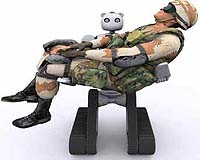
 Robots that use "guesswork" to navigate through unfamiliar surroundings are being developed by US researchers.
 Seapower is the official magazine of the Navy League but under the direction of Richard Barnard, Peter Atkinson, and Rick Burgess in recent years it has also emerged as a great source of future tech news and information.

 Scientists have expressed concern about the use of autonomous decision-making robots, particularly for military use.
 PARIS (AFP) - Imagine having someone to serve you a glass of water whenever you ask, or even dance if you put on your favourite music.