The propeller-driven submarines, or autonomous underwater vehicles (AUVs), currently perform a variety of functions, from mapping the ocean floor to surveying shipwrecks. But the MIT team hopes to create a more maneuverable, propeller-less underwater robot better suited for military tasks such as sweeping mines and inspecting harbors--and for that they are hoping to mimic the action of the bluegill sunfish.
Showing posts with label Unmanned Vehicles. Show all posts
Monday, 13 August 2007
Engineers Are Building Robotic Fin For Submarines
Unmanned "Surge": 3000 More Robots for War
Robo-Cars Picked for Pentagon Driving Test
That includes all five teams that completed 2005's Grand Challenge driverless rally across the desert.
Robot vehicles take on tough jobs
Got a destination too dirty or dangerous for a person to want to go there? The day could soon come when a robot vehicle takes humans' place as a matter of course.Scientists are focused on developing unmanned machines that can operate in the air, on the ground and under water, doing jobs where deploying people is just too dangerous.
Wednesday, 18 July 2007
Autonomous Flying Ambulances Could Save Troops
U.S. troops are pinned down in a crowded city center. Several are wounded and need immediate evacuation. There are miles of labyrinthine roads and thousands of enemy gunmen between them and the nearest base. The threat from rocket-propelled grenades has grounded the big helicopters.
Friday, 22 June 2007
An SR-72 in the works?
Ten years after the Air Force retired the SR-71 spy plane, Lockheed Martin’s legendary Skunk Works appears to be back at work developing a new Mach-6 reconnaissance plane, sources said.The Air Force has awarded Lockheed’s Advanced Development Projects arm a top-secret contract to develop a stealthy 4,000-mph (6,437 km/h) plane capable of flying to altitudes of about 100,000 feet, with transcontinental range. The plan is to debut the craft around 2020.
Read More
Thursday, 21 June 2007
Army's Greatest Inventions for 2006
Researchers behind the Army's top 10 greatest inventions for 2006 were recognized recently at a ceremony in Arlington, Virginia. The Army's Greatest Inventions for 2006 are:Blow Torch Counter Improvised Explosive Device System, U.S. Army Research Laboratory, Aberdeen Proving Ground, Md. This vehicle-mounted system detonates IEDs at safe stand-off distances, minimizing vehicle damage and Soldier injuries.
"It's fairly easy to operate, and it gives a sense of security to the Soldiers when they're on convoy duty," said Maj. Brian Hackenberg, who helped develop the system.
Integrated Robotic Explosive Detection System, U.S. Army Aviation and Missile Research, Development and Engineering Center, Redstone Arsenal, Ala. Capable of crossing rugged terrain, this remotely operated system incorporates an explosive trace detector onto a robotic platform.
Plastic Shaped Charge Assembly for Remote Destruction of Buried IEDs, U.S. Army Armament Research, Development and Engineering Center, Picatinny Arsenal, N.J. Remotely emplaced, the PSCA destroys known or suspected unexploded ordnance with higher accuracy than similar devices currently in use. Its low-fragmentation plastic housing eliminates collateral damage.
Humvee Crew Extraction D-ring, U.S. Army Aviation and Missile Research, Development and Engineering Center, Redstone Arsenal, Ala. Combat locks on the up-armored Humvee provide security for Soldiers but often get so damaged the doors can't be opened. The D-ring provides solid anchor points for the hooks of a tow strap, chain or cable to pull open damaged doors.
"There was an issue of Soldiers getting trapped inside Humvees that had been damaged for whatever reason ... enemy fire or being flipped. Soldiers had problems getting the doors off these up-armored Humvees so we took their advice and created the D-ring," said Wesley D. Patterson, who is part of a Fast Assistance in Sciences Team that deploys to help Soldiers solve problems that can be resolved within six months.
M1114 Humvee Interim Fragment Kit 5, U.S. Army Research Laboratory, Aberdeen Proving Ground, Md. This kit was fielded as a ballistic improvement for the M1114 Humvee in April 2006. A prototype door solution with fabrication and mounting instructions was provided within one week with automotive testing and safety certification.
Remote Urban Monitoring System, U.S. Army Communications-Electronics Research, Development and Engineering Center, Fort Belvoir, Va. RUMS hardware combines emerging technologies in Wireless Local Area Network technology, night-vision cameras and unattended ground sensors to eliminate false alarms. Tripped sensors transmit an alarm signal to the camera module and operator after video and audio from multiple camera modules confirm the unattended ground sensor's alarm signal.
Constant Hawk, U.S. Army Research Laboratory, Aberdeen Proving Ground, Md. Constant Hawk is a surveillance capability that uses an electro-optic payload to collect intelligence and identify areas that require increased surveillance by other assets.
OmniSense Unattended Ground Sensor System, U.S. Army Research Laboratory, Aberdeen Proving Ground, Md. OmniSense is an unattended ground sensor system used to detect and classify personnel and vehicles in perimeter defense.
EM113A2 Rapid Entry Vehicle, U.S. Army Armament Research, Development and Engineering Center, Picatinny, N.J. The REV provides rapid entry, non-lethal crowd control and rescue-squad insertion capabilities into areas requiring non-lethal intervention. The vehicle increases Soldier survivability through improved situational awareness and the ability to move and fire from within an armored vehicle.
BuckEye System, U.S. Army Engineer Research and Development Center, Vicksburg, Miss. BuckEye uses a digital camera to produce geospatial information for intelligence, surveillance and reconnaissance. It also produces high-resolution 3D urban mapping.
Chief Warrant Officer 4 Michael Harper said the BuckEye System has been instrumental in allowing a maneuver commander to rapidly map battle space through high-resolution imagery and to collect elevation data to give a 3D view.
"What it gives to Soldiers is added situational awareness they need to fight in an urban terrain," he said. "BuckEye has essentially mapped almost every major city in Iraq thus far."
Source: defensetech.org
Labels:
Air and Space,
C4ISR,
CIED,
Crowd control,
Non-lethal,
Robotics,
Unmanned Vehicles
Tuesday, 19 June 2007
French Research Agency Validates Flapping Wings for Micro Drone
Flapping wings might be better than rotors for a small surveillance UAV, engineers with the French aerospace research agency ONERA said June 18 at the 47th Paris Air Show.
ONERA’s simulation studies on a third-generation micro air vehicle dubbed Remanta show that such wings used less energy than a mini-helicopter design while delivering speedy flight, hover, endurance and agility, engineers Agnès Luc Boulah and Bruiec Danet said.
The Remanta is a partial demonstrator with a 15-centimeter wing and endurance of around 10 minutes. The micro-drone would fly on a programmed route into confined spaces, perform urban reconnaissance and send imagery for target acquisition and designation. The range would be a few hundred meters and include day/night capability.
Actuators would drive the flapping carbon-fiber wings. The major challenge is finding the power source, which must be compact and deliver 10 to 20 watts. Advances in power cells for mobile phones show promise.
A working demonstrator could be fielded in 10 years, the engineers said.
Labs in Cranfield and Shrivenham in Britain, German researchers and DARPA are also working on flapping wings for micro aerial vehicles.
Thursday, 14 June 2007
Can cyborg moths bring down terrorists?
A moth which has a computer chip implanted in it while in the cocoon will enable soldiers to spy on insurgents.At some point in the not too distant future, a moth will take flight in the hills of northern Pakistan, and flap towards a suspected terrorist training camp.
But this will be no ordinary moth.
Inside it will be a computer chip that was implanted when the creature was still a pupa, in the cocoon, meaning that the moth’s entire nervous system can be controlled remotely.
Read More
Top 10 Forecasts from Outlook 2007
Each year since 1985, the editors of THE FUTURIST have selected the most thought-provoking ideas and forecasts appearing in the magazine. Over the years, Outlook has spotlighted the emergence of such epochal developments as the Internet, virtual reality, and the end of the Cold War.
Here are the editors' top 10 forecasts from Outlook 2007:
1. Generation Y will migrate heavily overseas.
2. Dwindling supplies of water in China will impact the global economy.
3. Workers will increasingly choose more time over more money.
4. Outlook for Asia: China for the short term, India for the long term.
5. Children's "nature deficit disorder" will grow as a health threat.
6. We’ll incorporate wireless technology into our thought processing by 2030.
7. The robotic workforce will change how bosses value employees.
8. The costs of global-warming-related disasters will reach $150 billion per year.
9. Companies will see the age range of their workers span four generations.
10. A rise of disabled Americans will strain public transportation systems.
Read More
Here are the editors' top 10 forecasts from Outlook 2007:
1. Generation Y will migrate heavily overseas.
2. Dwindling supplies of water in China will impact the global economy.
3. Workers will increasingly choose more time over more money.
4. Outlook for Asia: China for the short term, India for the long term.
5. Children's "nature deficit disorder" will grow as a health threat.
6. We’ll incorporate wireless technology into our thought processing by 2030.
7. The robotic workforce will change how bosses value employees.
8. The costs of global-warming-related disasters will reach $150 billion per year.
9. Companies will see the age range of their workers span four generations.
10. A rise of disabled Americans will strain public transportation systems.
Read More
Labels:
Bandwidth,
Climate Change,
Future,
Medical,
Robotics,
Unmanned Vehicles
Monday, 11 June 2007
Faster "slamming" robots
SLAM is an acronym for 'simultaneous localization and mapping,' and slamming robots are simply robots which at the same time build a map of their environment while keeping track of their own localization.Now, according to New Scientist, Purdue University engineers have designed P-SLAM robots based on a prediction-based SLAM algorithm. This algorithm contains an environmental-structure predictor to predict the structure inside an unexplored region. As these robots make some guesses about their environments, they are able to react faster in unfamiliar buildings. But if this technique is working well in offices — which have some repetitive characteristics from room to room — it is not yet well-adapted to outdoor environments.
Tuesday, 5 June 2007
Naval Robot Wars
With a simple equation, Tom Ehrhard and Robert Work of CSBA lay out the benefits of UCASs for the CVW, saying the increase in range and stealth drones bring to the maritime strike fight are inarguable...
Tuesday, 29 May 2007
'Guessing' robots find their way
Merging of Man and Robot
The May issue of Seapower is no exception. Among features on micro air vehicles and new uses for fighter targeting pods is a cover story about the merging of man and robot to fight the wars of the not-so-distant future.
A Big Ball of Connectivity
No, it's not a giant beach ball. It's an ultralight, ultraportable antenna tucked inside an inflatable shell that can pull down a superfast broadband satellite connection at any location. The GATR-Com is designed for disaster-relief responders, far-flung video producers and front-line troops—anyone whose job (or life) depends on getting digital information—video, Internet, calls—in and out of remote places.
Monday, 28 May 2007
Bots on The Ground
The most effective way to find and destroy a land mine is to step on it.
This has bad results, of course, if you're a human. But not so much if you're a robot and have as many legs as a centipede sticking out from your body. That's why Mark Tilden, a robotics physicist at the Los Alamos National Laboratory, built something like that. At the Yuma Test Grounds in Arizona, the autonomous robot, 5 feet long and modeled on a stick-insect, strutted out for a live-fire test and worked beautifully, he says. Every time it found a mine, blew it up and lost a limb, it picked itself up and readjusted to move forward on its remaining legs, continuing to clear a path through the minefield.
Tuesday, 22 May 2007
Controlled Robots Anyone Can Build
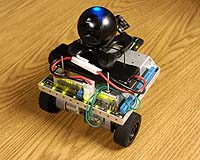
Carnegie Mellon University researchers have developed a new series of robots that are simple enough for almost anyone to build with off-the-shelf parts, but are sophisticated machines that wirelessly connect to the Internet.
The robots can take many forms, from a three-wheeled model with a mounted camera to a flower loaded with infrared sensors. They can be easily customized and their ability to wirelessly link to the Internet allows users to control and monitor their robots' actions from any Internet-connected computer in the world.
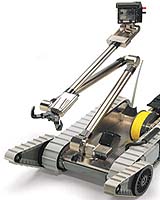
New Recon Robot For Military And Civil Use
Labels:
C4ISR,
CIED,
Counter-Terrorism,
Intelligence,
Robotics,
Unmanned Vehicles
Tuesday, 24 April 2007
Robot future poses hard questions
As they become more common, these machines could also have negative impacts on areas such as surveillance and elderly care, the roboticists warn.
Monday, 23 April 2007
French startup sees the future, and it includes robots
Now imagine that certain someone is a something -- a robot, in fact.
A French startup named Gostai is doing just that.
Link: Gostai
Labels:
Artificial Intelligence,
C4ISR,
Industry,
Robotics,
Unmanned Vehicles
Subscribe to:
Posts (Atom)