Showing posts with label Future. Show all posts

Monday, 13 August 2007

China Enacting a High-Tech Plan to Track People

Starting this month in a port neighborhood and then spreading across Shenzhen, a city of 12.4 million people, residency cards fitted with powerful computer chips programmed by the same company will be issued to most citizens.

Data on the chip will include not just the citizen’s name and address but also work history, educational background, religion, ethnicity, police record, medical insurance status and landlord’s phone number. Even personal reproductive history will be included, for enforcement of China’s controversial “one child” policy. Plans are being studied to add credit histories, subway travel payments and small purchases charged to the card.


Thursday, 9 August 2007

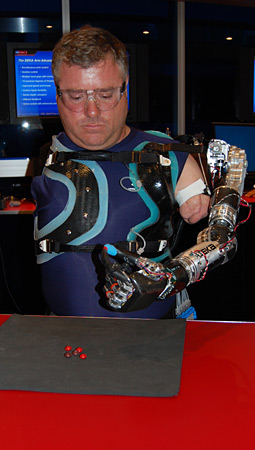
The Latest Bizarre Gizmos at the DARPATech Conference

ANAHEIM, Calif.—The Defense Advanced Research Projects Agency is approaching its golden anniversary, and there's reason to celebrate. If we can trust the commemorative deck of cards they're handing out at the DARPATech conference, the Pentagon's most radical, forward-thinking scientists have accounted for no fewer than 52 major technical innovations since 1958.

Check out the high-energy lasers on the four of diamonds, the night-vision goggles on the six of clubs, and the whizzing stealth fighter aircraft on the queen of hearts. And let's not forget the agency's trump card, here assigned to the jack of spades: Thirty-five years ago, DARPA helped create the earliest version of the Internet.

Wednesday, 8 August 2007

Pentagon Studies Human Microchip Implants

The Defense Department's plans to study implanting microchips in soldiers is already sparking concerns about privacy issues (and is likely to send the stock price of tinfoil to new highs).


Tuesday, 7 August 2007

Jim Rapoza's Ten Most Wanted Future Technologies


Infrastructure - Jim Rapoza's Ten Most Wanted Future Technologies

See Slideshow

Wednesday, 18 July 2007

The Risk Governance of Nanotechnology: Recommendations for Managing a Global Issue

Read the 6-7 July 2006 conference report: “The Risk Governance of Nanotechnology: Recommendations for Managing a Global Issue” (link to PDF) held at the Swiss Re Centre for Global Dialogue last summer.

This meeting is the highest profile meeting to include consideration of longer-term risks in nanotech.

Excerpt from the report (link to PDF) :

"Military offence applications are particularly concerning because, unlike nuclear arms, verification difficulties mean there is no clear point at which opponents reach stability in the process of escalation and proliferation. Existing arms treaties may not apply to nanotechnology-based weapons, and there are important intellectual property, commercial confidentiality, and national security issues involved in addressing this challenge…"

Monday, 25 June 2007

Jet engine tested at 10 times speed of sound

An experimental jet engine has been successfully tested at speeds of up to 11,000 km (6,835 miles) per hour, or 10 times the speed of sound, during trials in Australia's outback, defense scientists said on Friday.

The experimental scramjet engine is an air-breathing supersonic combustion engine being developed by Australian and U.S. defense scientists that researchers hope will lead to super-high speed flight.

Friday, 22 June 2007

Ghost Cities Of 2100

For 900 years, Moenjodaro, a city in what is now Pakistan, was the urban hub of a thriving civilization, the New York or London of its day. Around 1700 B.C., residents suddenly abandoned the Indus Valley city, and it was lost in the sands of time until archaeologists began excavating it in the 1920s.

Today, visitors can wander for hundreds of acres among its deserted streets and homes.

Text messaging could soon be the new way to call for help

Texting on your mobile could soon be the quickest way to call for police help.

The Government has given the go-ahead for a new 999 text-messaging emergency line which will work in tandem with the traditional call centre.

Soon typing in text speak "hlp 5-o sum1 hs brokN n2 my hous" - 'Help police, someone has broken into my house' - should summon an emergency response.


Read More

Tuesday, 19 June 2007

Turning cars into wireless network nodes

Taking It to the Streets: UCLA Scientists Seek to Turn Cars Into a Mobile Communications Network

It's no secret Americans love their cars, and modern computer systems have enhanced vehicle performance and safety. For computer science professor Mario Gerla and researcher Giovanni Pau at the UCLA Henry Samueli School of Engineering and Applied Science, the next step is to take that digital processing power and push it outward even further — by using cars as computer nodes in a mobile network on wheels.


ONARCHITECTURE- Intelligent design: Will robots take over architecture?


What if a building could build, repair, dismantle, and recycle itself? What if a building were equipped with sensors to track your movement through a space and could adapt its shape, texture, light, sounds, and heat to your presence? Finally, what if you could talk to a building and it could talk back?

Those are the kinds of questions students in UVA architecture professor Jason Johnson's Robotic Ecologies seminar are encouraged to ask and explore.


Monday, 18 June 2007

Online and offline worlds merge

Google has launched a tool designed to make it easier for computer users to use online applications offline.

One of the key limitations of web services such as e-mail, word processing and calendars, is that they require a net connection to function.


Thursday, 14 June 2007

China won't scrap blog registry

New rules by a Chinese government-backed Internet group maintain strict controls over the country's bloggers, requiring them to register with their real names and identification cards
.

The guidelines from the Internet Society of China (http://www.isc.org.cn), a group made up of China's major Internet companies, contradict state media reports this week claiming that China was considering loosening registration requirements for bloggers to allow anonymous online journaling.

Read More

Top 10 Forecasts from Outlook 2007

Each year since 1985, the editors of THE FUTURIST have selected the most thought-provoking ideas and forecasts appearing in the magazine. Over the years, Outlook has spotlighted the emergence of such epochal developments as the Internet, virtual reality, and the end of the Cold War.

Here are the editors' top 10 forecasts from Outlook 2007:

1. Generation Y will migrate heavily overseas.
2. Dwindling supplies of water in China will impact the global economy.
3. Workers will increasingly choose more time over more money.
4. Outlook for Asia: China for the short term, India for the long term.
5. Children's "nature deficit disorder" will grow as a health threat.
6. We’ll incorporate wireless technology into our thought processing by 2030.
7. The robotic workforce will change how bosses value employees.
8. The costs of global-warming-related disasters will reach $150 billion per year.
9. Companies will see the age range of their workers span four generations.
10. A rise of disabled Americans will strain public transportation systems.

Read More

Monday, 11 June 2007

New Book: Five minds for the future


We live in a time of accelerating globalisation, mounting information, growing hegemony of science and technology and clash of civilisations. Our time calls for new ways of learning and thinking in school, business and professions.


To know how psychologist Howard Gardner defines the cognitive abilities that will command a premium in future, read on. . .

Sunday, 10 June 2007

Scientists Create Fire-Safe, Green Plastic

Scientists from the University of Massachusetts Amherst have created a synthetic polymer-a building block of plastics-that doesn't burn, making it an attractive alternative to traditional plastics, many of which are so flammable they are sometimes referred to as "solid gasoline."

The new polymer wouldn't need the flame-retardant chemicals that are added to many plastics before they can be used in bus seats, airplanes, textiles and countless household items. Some of these additives have been showing up in dust in homes and offices, fish, fat cells and breast milk, raising concern that they pose a risk to human health and the environment. (The state of Washington recently banned a class of flame-retardants from use in household items from mattresses to computers-the first state to do so.)


Future of War

Military dictionaries say that what distinguishes war from peace is the massive use of weapons. But today this interpretation is desperately obsolete. The goal of a war of the future will not be to seize enemy territory but to deal surgical strikes against sensitive targets.

International borders are not violated, large-scale use of ground troops and armor is becoming a thing of the past, and the role of strategic aviation is diminished. The traditional nuclear triad is being replaced with non-nuclear high-accuracy weapons with different basing modes.


Tuesday, 29 May 2007

What will the world look like in 2017?


It’s not exactly “The Jetsons” — not yet, anyway — but the world is getting closer.

Thanks to some truly incredible technology, the world will look very different in 10 years:

  • Advances in miniaturization and wireless communication mean technology will be almost invisible but threaded throughout bedrooms, bathrooms, kitchens, living rooms and workplaces, the Copenhagen Institute for Futures Studies predicts. “All family members will be occupied with different activities, from playing piano to making cheese, brewing beer and designing clothes, to painting, backyard golf and fitness,” it says.

  • When everything is connected like this, the details of your life will be flying around the air. In that world, security becomes paramount. Forget face-recognition software; in 2017, it will be all about the eyes. “I think it’s possible to free us completely from our wallets and keys using biometric technology if that’s what people want in 10 years’ time,” said Don Monro, a professor at the University of Bath in England.

  • In 2017, more of us will be living with cancer, but the good news is that a cancer diagnosis will be quicker and easier — as simple as taking a breath. And when a frightening diagnosis comes in, effective treatments will be at hand. “We will start to see successful treatments for Alzheimer’s Disease that actually treat the disease process, not just the symptoms, like current drugs do,” said Dr. Rudolph Tanzi of Massachusetts General Hospital.

In short, it will be a world run by technology, and that means finding the people to oversee all that technology is the most critical task facing educators in the next decade. Shifting demographics mean many children will not be going to school but learning at home, instead, at a cyberschool.


Read More

Merging of Man and Robot

Seapower is the official magazine of the Navy League but under the direction of Richard Barnard, Peter Atkinson, and Rick Burgess in recent years it has also emerged as a great source of future tech news and information.

The May issue of Seapower is no exception. Among features on micro air vehicles and new uses for fighter targeting pods is a cover story about the merging of man and robot to fight the wars of the not-so-distant future.