Monday, 13 August 2007

Homeland Security tests automated "Hostile Intent" detector

An uncomfortable fact of modern security is that too many people go through transit hubs and to public events for all of them to be screened both efficiently and thoroughly. As a result, there has been a lot of attention focused on producing automated systems that screen crowds without the need for human intervention.

Automated biometric scans have serious limits, however, in that they can only identify people who have already been classified as threats. The Department of Homeland Security is hoping to overcome that limitation by automating the identification of individuals whose behavior suggests they pose a threat via a program dubbed "Hostile Intent."

Thursday, 9 August 2007

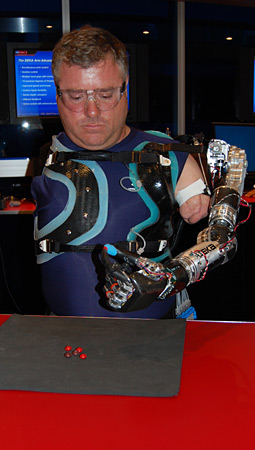
The Latest Bizarre Gizmos at the DARPATech Conference

ANAHEIM, Calif.—The Defense Advanced Research Projects Agency is approaching its golden anniversary, and there's reason to celebrate. If we can trust the commemorative deck of cards they're handing out at the DARPATech conference, the Pentagon's most radical, forward-thinking scientists have accounted for no fewer than 52 major technical innovations since 1958.

Check out the high-energy lasers on the four of diamonds, the night-vision goggles on the six of clubs, and the whizzing stealth fighter aircraft on the queen of hearts. And let's not forget the agency's trump card, here assigned to the jack of spades: Thirty-five years ago, DARPA helped create the earliest version of the Internet.

Land Warrior Proves Itself in Combat Ops

The Soldiers slip around the edge of the wall, stacking up against a rusty metal door blocking access to the compound. With a heavy punch of a boot, the entry is ripped from its hinges and the Soldiers pour into the hard-packed dirt yard in a flow of lethal green.

After a look around, the insurgent they were sent to nab isn't there.


Scientists Develop Metal That Explodes on Impact

This Navy test of a prototype warhead showed that reactive materials — inert compounds that ignite on impact — can increase the radius and lethality of a missile.

When most bombs go off, they release a spray of deadly shards of steel. Now, imagine that those shards were themselves explosive, detonating in a massive chain reaction. It's for real: Defense contractors are harnessing the strange alchemy of reactive materials (RMs) — in which two or more inert materials are mixed to create an explosion — to develop smaller, more lethal warheads, as well as new ways to protect troops against mortar rounds and rocket-propelled grenades.

Wednesday, 8 August 2007

Eric Schmidt Defines Web 3.0

Google CEO Eric Schmidt was recently at the Seoul Digital Forum where he was asked to define Web 3.0 by an audience member.

"Kill Proof," Animal-Esque Soldiers: DARPA Goal


DARPA, the Pentagon's way-out science arm wants to make soldiers stronger, faster, and generally "kill proof." The key, the agency believes: Getting humans to act more like animals.

For years, DARPA has been pushing to boost soldier performance. Today, at the opening of DARPATech, the agency's bi-annual conference, program manager Michael Callahan just announced a new effort to take that research even further. He calls it "Inner Armor."


DARPA Plays Spot the Suicide Bomber

How do you spot a suicide bomber? And even more important, how do you spot a suicide bomber before they get close enough to blow up their target?

To address this problem, DARPA this year started the Human-carried Explosive Detection Stand-off System (HEDSS) program to develop a system that can rapidly identify human carried explosives (HCEs) at ranges from 50 to 150 meters.