Monday, 11 June 2007

A swimming robot — inside your body

The Boston Globe describes the efforts of a Japanese-born scientist to develop new technologies for use in surgery. His last project is to build a swimming robot designed to explore the human gastrointestinal tract (GI tract) from esophagus to colon.

This 2-centimeter long robot will have a swimming tail to deliver the energy picked from the outside and use it to steer it in the GI tract. It will also be able to send back images to the physicians and to deliver therapy. Coincidentally, the Philadelphia Inquirer is reporting about another medical robot helper able to crawl like an inchworm into your heart.


Sunday, 10 June 2007

Scientists Create Fire-Safe, Green Plastic

Scientists from the University of Massachusetts Amherst have created a synthetic polymer-a building block of plastics-that doesn't burn, making it an attractive alternative to traditional plastics, many of which are so flammable they are sometimes referred to as "solid gasoline."

The new polymer wouldn't need the flame-retardant chemicals that are added to many plastics before they can be used in bus seats, airplanes, textiles and countless household items. Some of these additives have been showing up in dust in homes and offices, fish, fat cells and breast milk, raising concern that they pose a risk to human health and the environment. (The state of Washington recently banned a class of flame-retardants from use in household items from mattresses to computers-the first state to do so.)


Future of War

Military dictionaries say that what distinguishes war from peace is the massive use of weapons. But today this interpretation is desperately obsolete. The goal of a war of the future will not be to seize enemy territory but to deal surgical strikes against sensitive targets.

International borders are not violated, large-scale use of ground troops and armor is becoming a thing of the past, and the role of strategic aviation is diminished. The traditional nuclear triad is being replaced with non-nuclear high-accuracy weapons with different basing modes.


Friday, 8 June 2007

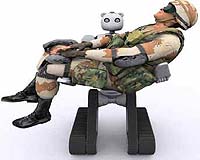
A Robot Is Built To Rescue Soldiers


U.S. researchers are developing a remote-controlled robot designed to rescue injured or abducted soldiers without putting their comrades at risk. The prototype of the nearly 6-foot-tall Battlefield Extraction-Assist Robot, called Bear, can lift nearly 300 pounds with one arm, and its developer, Vecna Technologies of College Park, Md., is focusing on improving its two-legged lower body.


Wednesday, 6 June 2007

What the attacks on Estonia have taught us about online combat.


In Estonia, you can pay for your parking meter via cell phone, access free Wi-Fi at every gas station, and, as of two months ago, vote in national elections from your PC.
The small, wired country can now add another item to this list of technological achievements: It's the first government to get targeted for large-scale cyberwarfare.

Tuesday, 5 June 2007

Naval Robot Wars

A new report drafted by the well-connected Center for Strategic and Budgetary Assessments makes a strong case for an accelerated development of unmanned combat aircraft for carrier battle groups.

With a simple equation, Tom Ehrhard and Robert Work of CSBA lay out the benefits of UCASs for the CVW, saying the increase in range and stealth drones bring to the maritime strike fight are inarguable...


Using technology to enhance humans


It's a well-known fact that technology can improve our lives. For example, we can reach anyone and anywhere with our cellphones. And people who can't walk after an accident now can have smart prosthesis to help them. But what about designing our children on a computer or having a chip inside our brain to answer our email messages? Are we ready for such a future?


In "Robo-quandary," the Milwaukee Journal Sentinel reports that many researchers are working on the subject. And as a professor of neuroscience said, "We can grow neurons on silicone plates; we can make the blind see; the deaf hear; we can read minds." So will all we become cyborgs one day?